

Running a shop often means facing headaches at the till and in the stockroom. Slow transactions and inventory mistakes can frustrate customers and sap your profits. Finding the right technology to keep your shop competitive is no longer a luxury—it’s an urgent need as modern retail races ahead.
You can cut wait times, reduce costly errors, and turn every shop visit into a more engaging experience by choosing the right tools. This list uncovers practical solutions that improve transaction speed, elevate inventory accuracy, and create smarter ways to connect with your customers. With actionable tips for POS, barcode scanners, and digital signage, you’ll discover how to build a smoother, more reliable retail operation.
Ready to learn which upgrades can give your shop a clear advantage? The following insights break down the best tools and strategies that help you serve your customers better, keep your data current, and gain business intelligence that drives growth.
Table of Contents
- Modern POS Terminals for Fast Transactions
- Barcode Scanners to Improve Inventory Accuracy
- Digital Signage for Enhanced Customer Engagement
- Mobile Point of Sale for Flexible Checkout
- Integrated POS Software for Better Business Insight
- Cloud-Based Solutions for Secure Operations
Quick Summary
| Key Message | Explanation |
|---|---|
| 1. Upgrade for Speed | Modern POS terminals process transactions in under 5 seconds, reducing waiting times and enhancing customer satisfaction. |
| 2. Automate Inventory Management | Barcode scanners eliminate human errors in stock tracking, increasing accuracy and speeding up restocking processes by up to 75%. |
| 3. Engage Customers with Digital Signage | Dynamic digital displays capture customer attention and can promote relevant offers in real time, thereby boosting sales. |
| 4. Implement Mobile POS for Flexibility | Mobile POS systems allow on-the-spot payments, improving customer service and reducing queue lengths during busy periods. |
| 5. Use Integrated POS Software for Insights | A unified POS system provides a complete view of sales and inventory, enabling informed decision-making based on real-time data. |
1. Modern POS Terminals for Fast Transactions
Speed matters in retail. Every second a customer waits at the till is a second they’re not browsing your shop or considering their next purchase. Modern POS terminals have moved far beyond simple payment boxes—they’re now intelligent systems that process transactions in seconds whilst managing your entire operation behind the scenes.
Today’s cloud-native POS systems integrate inventory tracking, customer data, and payment processing into one unified platform. This means when a customer buys an item, your stock updates instantly, their purchase history is recorded, and the transaction completes faster than traditional methods. The result? Shorter queues and happier customers.
Here’s what makes modern terminals essential for shop success:
- Process transactions in under 5 seconds on average
- Support multiple payment methods simultaneously (contactless, chip, mobile wallets)
- Operate reliably even with temporary internet disruptions
- Provide real-time sales data accessible from anywhere
- Reduce human error through automated workflows
The shift towards cloud-native, AI-driven POS platforms has transformed how retailers operate. Rather than managing isolated payment terminals, you’re now using systems that connect your till, inventory, and customer insights into one cohesive operation.
Consider a typical scenario: A customer approaches your till with five items. Your staff member scans each product in seconds. The terminal immediately checks stock levels, applies any loyalty discounts, offers suggestions for complementary products, and processes payment—all whilst maintaining a smooth, friction-free experience. Your customer leaves happy, and your inventory data is automatically updated across all your systems.
Modern terminals also handle the complexity of modern retail better than legacy systems. They support omnichannel commerce, meaning customers can shop online and collect in-store, or purchase in-store and return via post. The terminal knows about all these transactions and helps you manage them seamlessly.
Modern POS terminals aren’t just about accepting payments—they’re about understanding your customer and running your entire business more efficiently.
Payment speed alone justifies the upgrade. Faster transactions mean higher throughput during peak trading hours. During the pre-Christmas rush or bank holidays, every second counts. A system that processes transactions in 3 seconds instead of 10 seconds can serve 30% more customers in the same timeframe.
Implementing modern terminals requires choosing hardware that matches your shop’s specific needs. A busy high street shop may need multiple terminals with fast processing power, whilst a smaller boutique might need just one reliable unit. The key is matching terminal capability to your trading volume and customer expectations.
Pro tip: When evaluating modern POS terminals, prioritise processing speed and reliability over fancy features—test the system during your busiest trading hours to confirm it handles your peak volume without lag or errors.
2. Barcode Scanners to Improve Inventory Accuracy
Inventory mistakes cost you money. A single miscount can lead to stockouts when customers want to buy, or excess stock gathering dust on shelves. Barcode scanners eliminate the human error that comes with manual stock tracking by automating data entry and keeping your inventory records accurate.
When your staff member scans a product barcode, the system instantly records what’s been sold, received, or moved. This creates a real-time view of your stock across all locations. No more guessing whether you have five units or fifty. The data flows automatically into your POS system and inventory management software, updating your records in seconds.
The accuracy gains are substantial. Barcode scanners virtually eliminate data entry errors and can speed up warehouse processes by up to 75%. This means faster stock counts, quicker restocking, and fewer picking errors that frustrate both staff and customers.
Understanding barcode technology helps you choose the right scanner for your shop:
- 1D barcodes store basic product information (UPC and EAN codes on most retail items)
- 2D barcodes hold more data and work well for advanced inventory uses
- Handheld scanners offer flexibility for roaming staff during stocktakes
- Fixed-position scanners integrate seamlessly into checkout workflows
- Durability matters if your shop operates in demanding environments
Consider your shop’s specific needs. A small boutique might need one reliable handheld scanner for periodic stocktakes. A busy supermarket needs multiple scanners at tills plus portable units for warehouse staff. The right choice depends on your trading volume and operational complexity.
Proper barcode placement and system integration make the difference between a good scanner and a great one. If barcodes are damaged or placed where scanners can’t read them, you lose the accuracy advantage. Testing your scanner with your POS software before full rollout prevents frustration later.
Barcode scanners transform inventory management from a tedious manual process into an automated, accurate system that frees your staff to focus on customer service.
Implementing scanners changes how your team works. Staff spend less time counting items manually and more time helping customers. Cycle counts happen faster because scanning is quicker than writing down quantities. You catch stock discrepancies faster, meaning fewer surprises at year-end stocktaking.
Pro tip: Test your chosen scanner with your existing POS system and barcodes before purchasing in bulk—some scanners read certain barcode types more reliably than others, and compatibility ensures smooth operations.
3. Digital Signage for Enhanced Customer Engagement
Static posters on your shop walls blend into the background. Customers walk past them without a second glance. Digital signage changes this by displaying dynamic, eye-catching content that captures attention and drives purchasing decisions. When done right, it transforms your shop environment into an engaging space that keeps customers interested longer.
Modern digital signage goes far beyond displaying prices. These systems show real-time promotions, highlight bestselling items, and deliver messages tailored to different times of day. During morning commutes, you might advertise coffee and breakfast items. In the afternoon, promote lunch deals. By evening, feature dinner solutions. The content adapts to when customers actually want to buy.
Interactive digital signage takes engagement further by inviting customer participation. Touchscreen displays let shoppers browse product details, check availability, or access special offers. This creates memorable experiences that keep customers in your shop longer and increase the likelihood of additional purchases.
Key benefits of digital signage include:
- Display real-time inventory and availability
- Update promotions instantly without reprinting materials
- Show relevant content based on time of day or season
- Create engaging experiences that increase customer dwell time
- Integrate with your POS system for cohesive messaging
- Reduce printing costs whilst maintaining fresh, professional appearance
AI-driven content adaptation and personalised promotions represent the future of digital signage. These systems analyse customer behaviour and demographics to deliver precisely targeted messages. When a customer of a particular age group approaches a display, the content can adjust automatically to show products most relevant to them.
Consider a practical example. You run a high street fashion shop. Digital signage displays your latest collection near the entrance, grabbing attention from passing pedestrians. Inside, interactive screens in fitting rooms show styling suggestions and product reviews. At the till, signage promotes last-minute impulse buys or loyalty programme sign-ups. Every screen works together to enhance the customer journey.
Integration with your POS system creates powerful synergies. When an item sells out, your signage automatically removes it from promotional displays. When stock needs shifting before a new delivery arrives, promotions update instantly across all screens. This keeps your shop environment honest and efficient.
Digital signage transforms how customers perceive and interact with your shop, turning displays into active sales tools rather than passive decorations.
Implementing digital signage requires choosing the right hardware and software for your space. Screen size, placement, and content management systems all matter. A small shop might need one eye-catching entrance display. A larger retailer benefits from multiple screens strategically positioned throughout the space.
Pro tip: Start with one high-traffic location where a digital display will have maximum impact, then expand based on results—this approach lets you prove ROI before investing in shop-wide installation.
4. Mobile Point of Sale for Flexible Checkout
Your customers are queuing at the till whilst your staff member manually rings up each item. Meanwhile, other staff members stand idle on the shop floor. Mobile POS (mPOS) changes this scenario entirely by untethering checkout from a fixed counter and empowering your team to process payments anywhere in your shop.
Mobile POS runs on handheld devices like tablets or smartphones, transforming them into complete payment terminals. Your staff can approach customers standing in the aisle, queue, or fitting room and complete transactions on the spot. No more walking to the till. No more queuing. Transactions happen where customers are.
This flexibility addresses a real pain point in retail. During busy periods, a single fixed till becomes a bottleneck. Mobile POS systems enable retailers to process payments anywhere in the store, freeing staff from checkout stations and dramatically reducing waiting times. Customers perceive shorter queues, which improves their shopping experience and increases satisfaction.
The practical benefits extend beyond checkout speed:
- Accept contactless and chip payments anywhere in your shop
- Process sales before items reach a fixed till
- Reduce queue lengths during peak trading hours
- Enable staff to serve customers more attentively
- Support spontaneous purchases in fitting rooms or aisles
- Integrate with your main inventory system for accurate stock tracking
Consider how mPOS changes your shop operations. A customer in the fashion section picks up several items and decides to purchase. Your staff member uses a mobile device right there to process payment, bag items, and issue a receipt. The customer leaves satisfied, and your inventory updates instantly. Another team member remains on the shop floor to assist other shoppers.
Mobile POS also supports omnichannel commerce seamlessly. Customers who order online can collect purchases in-store and pay immediately. Customers browsing physical shops can check online availability. Everything connects through your POS system, creating a unified retail experience.
Security and reliability matter when processing payments on mobile devices. Modern mPOS systems encrypt payment data, meet industry compliance standards, and work reliably even with temporary connectivity interruptions. Your shop’s security posture remains strong.
Mobile POS transforms your shop floor into a dynamic sales environment where checkout happens where customers are, not where your infrastructure forces them to go.
The technology works best when integrated with your existing POS system and inventory management. When a sale completes on a mobile device, your till drawer updates, inventory decreases, and customer records are created automatically. This integration ensures your business data remains accurate.
Pro tip: Introduce mobile POS during your busiest trading hours first—this lets your team adapt to the technology when transaction volume justifies the need and builds confidence before expanding to quieter periods.
5. Integrated POS Software for Better Business Insight
Data sits trapped in separate systems. Your till knows about sales but not inventory. Your inventory system tracks stock but ignores customer preferences. Your accounting software never sees customer purchase patterns. This fragmentation blinds you to opportunities. Integrated POS software breaks down these silos and gives you the complete picture of your business.
When payment processing, inventory management, customer data, and analytics live in one unified platform, magic happens. You see which products sell well together. You understand which customers buy most frequently. You spot seasonal trends before competitors do. You make decisions based on real data, not guesswork.
Integrated POS systems combine multiple business functions into a single source of truth. Every transaction updates your inventory automatically. Every customer interaction builds their purchasing profile. Every sale flows directly into your accounts. Information flows seamlessly between departments and systems.
Consider the practical benefits:
- Access real-time sales data from anywhere on your smartphone
- Automate inventory reordering when stock hits specific thresholds
- Track which customers spend most and reward their loyalty
- Analyse sales patterns to optimise staffing and stock levels
- Connect your POS directly to accounting software for faster financial reporting
- Identify bestselling products instantly without manual counting
- Forecast demand more accurately using historical data
Cloud-native, AI-driven POS platforms unify inventory, customer data, and predictive analytics into one intelligent system. These modern solutions provide real-time insights that help you reduce costs and position your shop competitively.
Imagine running your shop with complete visibility. A customer purchases five items. You instantly see their purchase history, preferences, and lifetime value. Your inventory updates automatically. Your accounting software records the transaction. Your email system can trigger a personalised follow-up message. All of this happens without manual intervention.
Real-time reporting becomes your competitive advantage. During the school holidays, you notice demand for certain products peaks. You increase stock before the rush hits. A competitor runs out. You capture their customers. Your integrated system made this possible.
Integrated POS software transforms raw transaction data into actionable business intelligence that guides smarter decisions every single day.
Implementing integrated software requires choosing a system that scales with your business. A small independent shop has different needs than a multi-location retailer. The right software grows with you, adding functionality as your shop expands.
Integration with accounting packages saves your accountant hours every month. Sales data flows directly into your financial records. Year-end reconciliation becomes faster and more accurate. You spend less time on paperwork and more time growing your business.
Pro tip: Before switching to integrated POS software, audit your current data sources and identify which information you most need to see together—this focus ensures you choose a system that solves your specific business challenges.
6. Cloud-Based Solutions for Secure Operations
Servers humming in a dusty back room. Data backed up on external hard drives scattered across your shop. Manual security updates that you might remember to run. This approach feels outdated because it is. Cloud-based POS solutions handle all of this automatically, keeping your business data safer and more accessible than ever before.
Cloud POS systems store your data on secure, professionally managed servers rather than relying on hardware sitting in your shop. Your sales data, customer information, and inventory records live in encrypted databases accessed through the internet. This approach offers significant advantages over traditional on-premises systems.
Automatic updates and maintenance happen without disrupting your operations. Security patches deploy immediately when vulnerabilities are discovered. Your system never runs outdated software that hackers could exploit. Backups happen continuously, so you never lose critical business data even if disaster strikes your physical location.
Security frameworks protect your data in cloud environments:
- Encryption protects sensitive information both in transit and at rest
- Role-based access controls ensure only authorised staff see sensitive data
- Continuous monitoring detects suspicious activity instantly
- Regular security audits identify vulnerabilities before hackers find them
- Incident response plans activate immediately if breaches occur
- Compliance with regulations like GDPR and PCI DSS is built in
Data protection strategies including encryption, role-based access, and continuous monitoring safeguard sensitive information in cloud environments. These layers of security work together to create protection far stronger than most shops can achieve independently.
Consider what happens during a power cut. Your cloud POS remains accessible from a mobile device using your shop’s mobile connection. You keep serving customers whilst your on-premises competitors sit in the dark. When a fire destroys your building, your data survives untouched in secure data centres miles away.
Real-time data access from anywhere transforms how you manage your business. Check sales figures from home. Respond to inventory issues whilst away. Authorise transactions remotely during emergencies. Your shop operates seamlessly with or without you physically present.
Cost savings accumulate over time. You eliminate expensive server hardware. You avoid paying IT staff to maintain systems. You sidestep the burden of managing security yourself. Cloud providers handle all of this, spreading costs across many customers and offering economies of scale.
Cloud-based solutions transform POS from a shop-based system into a business-wide platform that keeps your data secure, accessible, and always current.
Multi-location retailers benefit tremendously from cloud architecture. All your shops report to one unified system. Customer data syncs across locations instantly. A customer who shops in Manchester today and London tomorrow receives consistent experiences at both locations.
Pro tip: When evaluating cloud POS providers, confirm they maintain multiple data centre locations for redundancy—this ensures your data survives even if an entire data centre fails unexpectedly.
Below is a comprehensive table summarising the main components, benefits, and implementation considerations for modern retail technologies as discussed throughout the article.
| Technology | Benefits | Considerations |
|---|---|---|
| Modern POS Terminals | Improve transaction speed, integrate operations, and enhance customer satisfaction. | Prioritise reliability and processing speed when selecting terminals compatible with trading volumes. |
| Barcode Scanners | Increase inventory data accuracy and streamline stock management processes. | Test scanner compatibility with existing systems and ensure optimal barcode placement for efficiency. |
| Digital Signage | Engage customers through dynamic and interactive content tailored to shopping behaviour. | Consider screen placement, content management systems, and test for ROI. |
| Mobile Point of Sale (mPOS) | Enhance customer service flexibility and reduce queuing times through on-the-go payment options. | Ensure seamless integration with current POS and validate systems during busy periods. |
| Integrated POS Software | Centralise business operations, enabling data-driven decision-making and streamlined inventory management. | Assess existing data requirements to ensure the chosen system meets operational needs. |
| Cloud-Based Solutions | Secure data storage with automatic updates and support for real-time access. | Confirm data provider’s compliance with security standards and features such as redundancy. |
Unlock Retail Efficiency with YCR Distribution’s POS Solutions
The article highlights how modern retail technology resolves challenges like slow transactions, inventory inaccuracies, and fragmented data. If you struggle with long queues, stock errors, or disconnected business systems, embracing integrated POS hardware and software is crucial. From fast-processing POS terminals and reliable barcode scanners to versatile mobile POS and real-time digital signage, these innovations transform customer experience and streamline operations.
At YCR Distribution, we understand these pain points deeply. With over 30 years of expertise, we provide trusted POS solutions tailored for UK retailers and hospitality businesses. Our range includes industry-leading terminals from SAM4S and iMin, advanced barcode scanners, and bespoke POS software like SAMTOUCH and EZEEPOS. All products are designed to help you speed up transactions, maintain perfect inventory control, and gain actionable insights through integrated cloud platforms.
Experience the difference by choosing YCR as your total POS solutions partner. Act now to reduce errors, cut queue times, and elevate customer satisfaction.
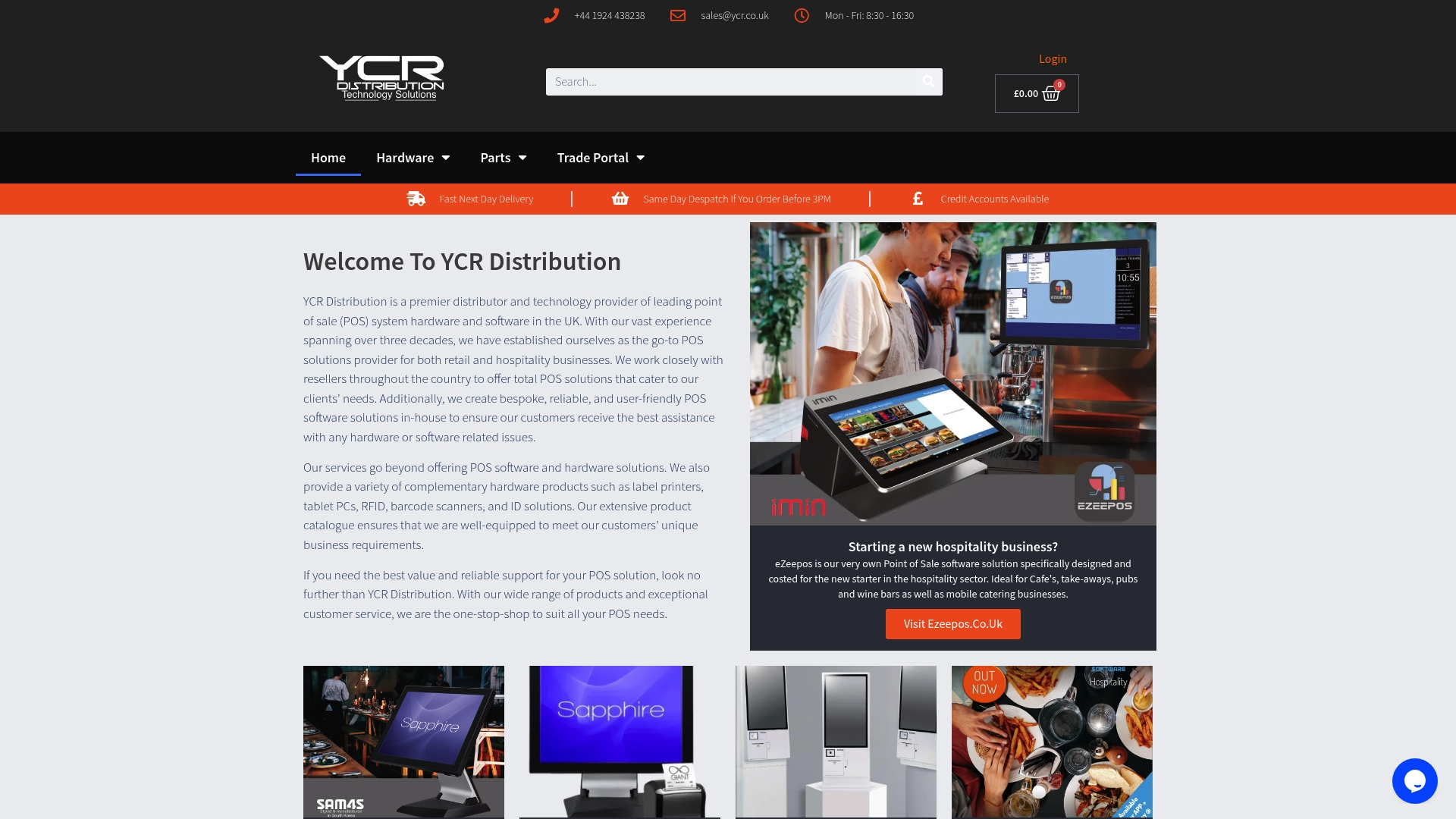
Explore how our complete POS ecosystem can transform your retail success at YCR Distribution. Discover fast, reliable hardware and software combined into one seamless platform designed to boost your shop’s efficiency and profitability. Visit us today and take the next step toward smarter retail technology.
Frequently Asked Questions
How can modern POS terminals speed up transactions in my shop?
Modern POS terminals can process transactions in under five seconds, significantly enhancing checkout speed. To fully benefit, assess the processing capability of multiple terminals during peak hours to ensure they can handle your customer volume.
What are the key advantages of using barcode scanners for inventory management?
Barcode scanners greatly improve inventory accuracy by virtually eliminating data entry errors and providing real-time stock updates. Implement scanners within your inventory system to experience a potential reduction in stock discrepancies by around 75%.
How does digital signage enhance customer engagement in retail?
Digital signage captures customer attention with dynamic content and tailored promotions that adapt to different times of day. Start with one high-traffic area to test its effectiveness before expanding to additional locations based on engagement results.
What features should I look for in a mobile POS system?
When selecting a mobile POS system, prioritise the ability to process various payment types from anywhere in the store and integrate seamlessly with your inventory management. Introduce mPOS during your busiest trading times to allow staff to become familiar with the system while maximising sales opportunities.
How can I achieve better business insights with integrated POS software?
Integrated POS software connects sales, inventory, and customer data into one system, providing a complete overview of your business operations. Focus on identifying which data sources you need to combine for more informed decision-making and improved stock management.
What are the benefits of using cloud-based POS solutions?
Cloud-based POS solutions offer automatic updates and secure data storage, improving accessibility and reducing the risk of data loss. Evaluate potential providers based on their data centre redundancy to ensure your business operations remain secure and uninterrupted.