

Secure transactions in POS: a guide for retailers

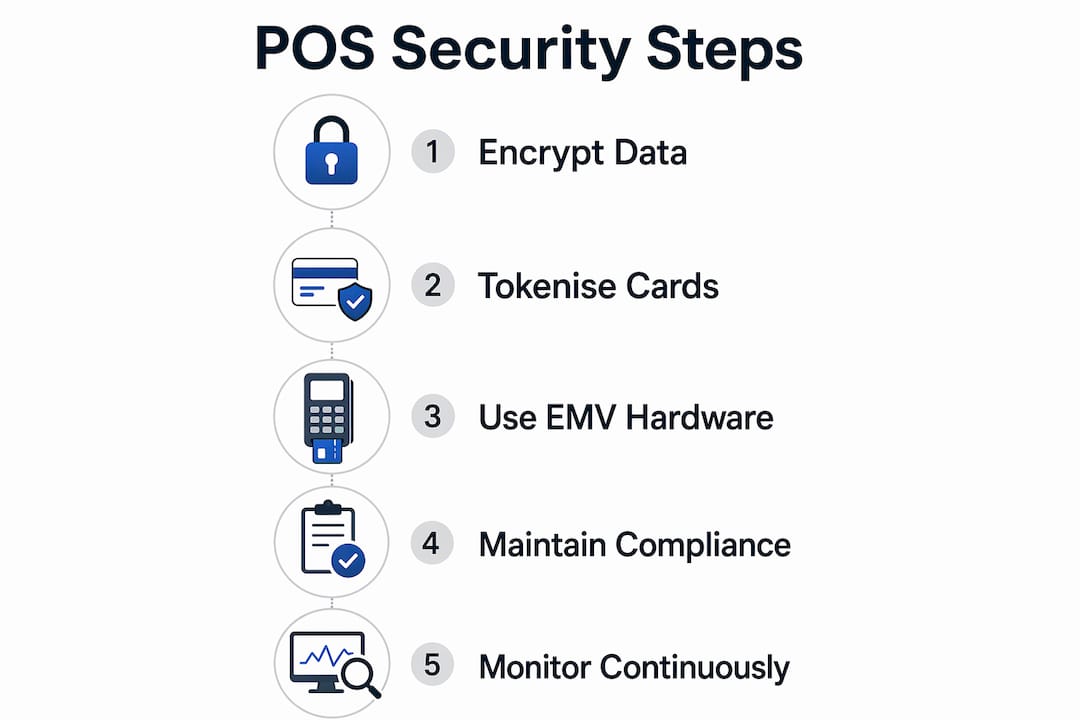
Secure transactions in POS systems are defined as the end-to-end protection of payment data from the moment a card is presented at the terminal through to authorisation and storage. Every retail and hospitality business that accepts card payments faces the same core risk: cardholder data is valuable, and attackers target the points where it is most exposed. The technologies that address this, including EMV chip cards, point-to-point encryption (P2PE), tokenisation, and PCI DSS compliance, form the foundation of modern POS transaction security. Getting these layers right is not optional. Merchants using non-EMV terminals bear 100% of fraud losses, while those with EMV-compliant hardware shift that liability to the issuing bank.
What technologies secure POS transactions?
Three technologies form the core of any secure payment system at the point of sale: P2PE encryption, tokenisation, and EMV chip cards. Each addresses a different vulnerability in the payment chain.
Point-to-point encryption (P2PE)
PCI-validated P2PE encrypts card data at the exact moment of capture, before it ever touches your POS software or network. The data remains unreadable until it reaches a secure, off-site decryption environment operated by the payment processor. This single step dramatically reduces your PCI DSS compliance scope, because there is no readable cardholder data on your premises to protect. For a busy restaurant or retail store, that means fewer systems, fewer audits, and a smaller attack surface.

Tokenisation
Tokenisation replaces a customer’s card number with a randomly generated token that has no value outside your specific payment system. Stolen tokens are useless to an attacker because they cannot be reversed into real card data. The best POS security architecture follows a “capture secure, process minimal, store tokenised” approach. This means your systems never hold live card numbers after a transaction completes, which limits the damage of any breach significantly.
EMV chip cards and PCI PTS hardware
EMV chip cards generate a unique transaction code for every payment, making cloned card fraud almost impossible. POS terminals use TLS 1.2+ to encrypt communication between the terminal and the payment gateway during processing. PCI PTS certification for hardware confirms that the physical device meets tamper-resistance standards. Choosing PCI PTS-certified terminals, such as those in the SAM4S range distributed by Ycr, means the hardware itself is independently verified as secure.
| Technology | What it protects | How it works |
|---|---|---|
| P2PE | Card data at capture | Encrypts data before it enters your network |
| Tokenisation | Stored transaction records | Replaces card numbers with valueless tokens |
| EMV chip | Card cloning and counterfeit fraud | Generates a unique code per transaction |
| TLS 1.2+ | Data in transit | Encrypts the channel between terminal and gateway |
| PCI PTS | Physical terminal | Certifies hardware tamper resistance |
Pro Tip: When evaluating a POS terminal, ask your supplier for the PCI PTS certification number and verify it directly on the PCI Security Standards Council website before purchase.
How does PCI DSS compliance protect your payment environment?
PCI DSS (Payment Card Industry Data Security Standard) is the global framework governing how businesses handle cardholder data. Compliance is not a one-time event. It is an ongoing operational requirement that covers your hardware, software, network, and staff behaviour.
A critical distinction that many business owners miss: being “PCI compliant” is not the same as using a “PCI-validated P2PE solution.” A terminal may carry PCI certification on its own, but the full solution, including the application, the decryption environment, and the processes around it, must appear on the PCI SSC’s official solution listing. Relying on a single component’s certification can leave your business exposed. Always verify the complete solution listing, not just the device.
The EMV liability shift reinforces this point commercially. Under current card scheme rules, if a fraudulent transaction occurs on a chip card at a non-EMV terminal, the merchant pays. That financial exposure is entirely avoidable with the right hardware.
Compliance must-dos for retail and hospitality owners:
- Verify your POS solution appears on the PCI SSC’s validated solution list, not just the terminal
- Use a PCI-validated P2PE solution to reduce your compliance scope and audit burden
- Confirm your payment gateway uses TLS 1.2 or higher for all data in transit
- Never store full card numbers, CVV codes, or PIN data after authorisation
- Complete your annual PCI DSS self-assessment questionnaire (SAQ) or full audit as required by your acquirer
- Review your compliance status after any hardware or software change
Pro Tip: Your acquiring bank can tell you which SAQ type applies to your setup. A P2PE-validated solution typically qualifies you for the shorter SAQ P2PE form, saving significant time and cost.
What best practices protect POS transactions from threats?
Technology alone does not secure a POS environment. Operational controls are equally important, and they are where most breaches actually originate.
Access control and authentication
Administrative access is frequently the weakest link in POS security. Default credentials, shared logins, and accounts that are never revoked when staff leave create serious vulnerabilities. Every user who touches your POS system should have a unique login with the minimum permissions needed for their role. When a staff member leaves, revoke their access the same day. Fast, passwordless MFA using biometrics or badge-based login prevents bottlenecks at the till while maintaining strong identity verification. Solutions like OLOID demonstrate that speed and security are not mutually exclusive at the register.
Network segmentation
POS networks must be isolated from public Wi-Fi and office networks using VLANs or separate physical infrastructure. An unsegmented network allows an attacker who gains access via your guest Wi-Fi to move laterally and reach your payment terminals. This is one of the most common attack paths in retail environments and one of the easiest to close. Treat your POS network as a separate, locked room that only payment devices can enter.
Continuous monitoring
24/7 SOC-style monitoring is the standard recommendation for POS environments. Attackers deliberately time attacks around peak trading periods such as Black Friday, when staff are distracted and transaction volumes are high. Monitoring tools should restrict network traffic to approved endpoints only, flagging any unexpected outbound connections immediately. For smaller businesses without an in-house IT team, managed security services provide this coverage without the overhead.
Numbered steps to protect your POS environment:
- Assign unique credentials to every staff member and enforce role-based access from day one
- Segment your POS network from all other business and public networks using VLANs
- Enable 24/7 monitoring or subscribe to a managed security service that covers your trading hours
- Restrict outbound network traffic to approved payment processor endpoints only
- Audit physical terminals regularly for signs of tampering or skimming devices
- Revoke all access credentials immediately when a staff member leaves the business
Pro Tip: Physical tamper checks take under two minutes per terminal. Build them into your opening checklist alongside cash float counts. Attackers install skimming devices overnight or during quiet periods.
How do you verify and maintain POS security over time?
Security is not a setup task. It requires ongoing verification, patching, and staff engagement to remain effective. The PCI compliance lifecycle demands that businesses treat encryption, minimal data processing, and tokenised storage as continuous operational standards, not a one-off configuration.
Start by checking your POS vendor’s certification status on the PCI SSC website at least once a year. Vendors occasionally lose their validated status if they fail to maintain compliance. A terminal that was certified when you bought it may no longer qualify if the vendor has not kept up with PCI requirements.
Regular staff training on PCI requirements and correct handling of payment data reduces accidental exposure significantly. Technology safeguards and trained staff work together. One without the other leaves gaps. For retail POS data security in particular, staff awareness of phishing attempts and social engineering is as important as any technical control.
| Verification task | Frequency | Purpose |
|---|---|---|
| PCI SSC solution listing check | Annual | Confirm vendor and solution remain validated |
| Firmware and software patching | Monthly or as released | Close known vulnerabilities promptly |
| Physical terminal tamper audit | Daily (opening checks) | Detect skimming devices or physical tampering |
| Staff PCI awareness training | Annual minimum | Reduce accidental data exposure |
| Access credential review | Quarterly | Remove stale accounts and excess permissions |
| Network segmentation audit | Annual | Verify POS network remains isolated |
Pro Tip: Subscribe to the PCI SSC’s email alerts. They notify you when validated solutions are added, removed, or updated, so you do not need to check manually every month.
Key takeaways
Secure POS transactions require layered protection: P2PE encryption at capture, tokenised storage, EMV-certified hardware, network segmentation, and ongoing staff training working together.
| Point | Details |
|---|---|
| P2PE reduces compliance scope | Encrypting card data at capture removes readable data from your premises entirely. |
| EMV shifts fraud liability | Non-EMV terminals leave merchants bearing 100% of counterfeit fraud losses. |
| Full solution listing matters | Verify the complete PCI P2PE solution listing, not just the terminal certification. |
| Network segmentation is non-negotiable | Isolating POS networks via VLANs closes the most common lateral attack path. |
| Security is an ongoing cycle | Monthly patching, annual audits, and regular staff training sustain protection over time. |
Why most POS security failures are not technical
After working closely with retail and hospitality businesses across the UK, the pattern I see most often is not a failure of technology. It is a failure of assumption. Business owners invest in a certified terminal, tick the PCI box at setup, and then treat security as done. That assumption is where the real risk lives.
The terminal is the most visible part of your payment environment, but it is rarely where breaches begin. Attackers target the network around it, the credentials of the staff who access it, and the software that processes data after the terminal has done its job. I have seen businesses with excellent hardware running on completely flat networks, where a single compromised staff laptop could reach every payment device on site.
The other misconception I encounter regularly is that security creates friction at the till. It does not have to. Modern passwordless MFA, such as badge-tap or fingerprint login, is faster than typing a PIN. Secure payment workflows can actually speed up transactions when they are designed well. The businesses that get this right treat security as part of their operational design, not a constraint imposed on top of it.
My honest recommendation: audit your network segmentation before you audit anything else. It is the control that costs the least to implement and closes the most significant attack path. Everything else builds from there.
— John
How Ycr supports secure POS transactions in retail and hospitality
Ycr has supplied certified POS hardware and software to UK retail and hospitality businesses for over three decades. The SAMTOUCH POS software with hardware bundle pairs PCI-compatible terminals with software built for the demands of busy trading environments, supporting the encryption and access control features covered in this guide.

For businesses that need software flexibility, TOUCHPOINT software offers a reliable foundation for secure transaction processing in hospitality settings. Ycr also stocks a full range of certified POS hardware including SAM4S and iMin terminals, scanners, and peripherals, all available with next-day delivery and same-day dispatch. If you are reviewing your current setup against the standards covered here, the Ycr team can advise on hardware certification and solution compatibility.
FAQ
What does P2PE mean in POS security?
P2PE stands for point-to-point encryption. It encrypts card data at the moment of capture so that no readable cardholder information passes through your POS system or network.
Is PCI DSS compliance the same as using a validated P2PE solution?
No. PCI DSS compliance covers your overall data security practices, while a PCI-validated P2PE solution is a specific, listed product that meets stricter encryption standards and reduces your compliance scope.
What is the EMV liability shift?
The EMV liability shift means that if a fraudulent transaction occurs on a chip card at a terminal that does not support EMV, the merchant bears the full financial loss rather than the card issuer.
How often should POS software be updated?
POS software and firmware should be patched monthly at minimum, or immediately when a security update is released by the vendor. Unpatched systems are one of the most common entry points for attackers.
Does network segmentation really matter for small businesses?
Yes. Unsegmented networks allow attackers who access your guest Wi-Fi or office network to reach your payment terminals directly. A VLAN or separate network for POS devices closes this path at minimal cost.