

Selecting the right POS hardware can feel overwhelming with so many options on the market. Yet this decision directly impacts your daily operations, customer satisfaction, and bottom line. Whether you run a bustling café, a retail boutique, or a multi-site restaurant chain, understanding the main types of POS hardware and how they align with your business needs is essential. This guide breaks down the key hardware categories, compares their features, and helps you make informed choices that enhance efficiency and service quality.
Table of Contents
- Key takeaways
- How to evaluate POS hardware for your business
- Seven key types of POS hardware devices
- Comparing POS hardware: features, pros and cons
- Choosing the right POS hardware for your retail or hospitality business
- Explore POS hardware solutions with YCR Distribution
- Frequently asked questions
Key Takeaways
| Point | Details |
|---|---|
| Environment driven hardware | Assess your business environment to match hardware durability and form factor to your venue, such as high traffic or compact spaces. |
| Compatibility and integration | Check compatibility with your POS software and request trial periods to verify smooth integration. |
| Scalable and modular design | Prefer modular, cloud connected devices that can grow with your business and support new payment methods. |
| Total cost of ownership | Focus on total cost of ownership, recognising that cheaper hardware can incur higher maintenance and longer term costs. |
How to evaluate POS hardware for your business
Before diving into specific hardware types, establish clear evaluation criteria that reflect your operational reality. Start by identifying your business environment. A quick-service restaurant faces different demands than a clothing boutique, and hardware durability requirements vary accordingly. High-traffic venues need rugged devices that withstand constant use, whilst smaller operations may prioritise compact, multifunctional units.
Compatibility sits at the heart of any hardware decision. Your POS hardware must work flawlessly with your existing or planned software platform. Mismatched systems create bottlenecks, data sync issues, and frustrated staff. Check compatibility with POS software and ease of integration before committing to any purchase. Many suppliers offer compatibility matrices or trial periods to verify seamless operation.
Scalability deserves serious consideration, especially if you plan to expand. Hardware that meets today’s needs but cannot accommodate future growth becomes a costly mistake. Look for modular systems that allow you to add terminals, printers, or payment devices as your business evolves. Future-proof options include cloud-connected devices and equipment supporting emerging payment methods like digital wallets and contactless cards.
Budget constraints are real, but focus on total cost of ownership rather than upfront price alone. Cheaper hardware often requires more frequent repairs or replacements, ultimately costing more. Calculate return on investment by considering transaction speed improvements, reduced error rates, and enhanced customer throughput. A slightly higher initial investment in quality hardware typically pays dividends through reliability and longevity.
User-friendliness directly affects staff productivity and training costs. Intuitive interfaces reduce onboarding time for new employees and minimise transaction errors. Touch-screen terminals with clear layouts enable faster service, whilst complicated systems slow operations and frustrate both staff and customers.
Pro tip: Create a weighted scorecard listing your top five priorities (durability, cost, compatibility, ease of use, scalability) and rate each hardware option against these criteria. This structured approach removes emotion from the decision and ensures you select equipment that truly fits your business model.
Seven key types of POS hardware devices
Understanding the role each hardware type plays helps you build a complete, efficient system. These seven essential POS hardware examples form the backbone of modern retail and hospitality operations.
POS terminals serve as the central command centre for processing sales transactions. These devices run your POS software, display product catalogues, calculate totals, and manage inventory updates in real time. Modern terminals range from traditional fixed units to mobile tablets that enable tableside ordering or shop floor assistance. They typically feature touch-screen interfaces, built-in card readers, and connectivity options for peripheral devices.

Barcode scanners dramatically speed up item identification whilst eliminating manual entry errors. Retail environments with extensive product ranges benefit enormously from handheld or fixed scanners that instantly retrieve pricing and product data. These devices connect via USB, Bluetooth, or wireless networks, with laser and imaging technologies each offering distinct advantages for different scanning scenarios.
Receipt printers provide customers with transaction proof whilst reinforcing your brand through customised receipts. Thermal printers dominate the market due to their speed, reliability, and low maintenance requirements. They eliminate the need for ink cartridges and produce clear, fade-resistant receipts. Some models support logo printing and promotional messaging, turning every receipt into a marketing opportunity.
Cash drawers secure cash handling within the transaction workflow, opening automatically when triggered by the POS terminal. They include multiple compartments for notes and coins, lockable mechanisms for security, and durable construction to withstand constant daily use. Proper cash drawer integration ensures accurate cash reconciliation and reduces theft risk.
Customer displays mount facing the customer, showing transaction details, itemised pricing, and payment amounts in real time. This transparency builds trust and reduces disputes by allowing customers to verify purchases as they occur. Some displays also show promotional content or loyalty programme information between transactions.
Payment terminals and card readers enable diverse payment methods including chip and PIN, contactless, and mobile wallet transactions. Integrated or standalone units connect to your POS system, processing payments securely whilst maintaining PCI compliance. Modern terminals support multiple payment types simultaneously, reducing checkout friction and accommodating customer preferences.
Kitchen and order printers specifically serve hospitality venues, delivering orders instantly to kitchen or bar stations. These specialised printers withstand heat, moisture, and grease whilst producing clear, legible tickets that organise workflow and reduce miscommunication. Multiple printer stations enable order routing to appropriate preparation areas, streamlining service delivery.
Comparing POS hardware: features, pros and cons
Weighing hardware options side by side reveals which devices best match your operational priorities and constraints.
| Hardware type | Key features | Main benefits | Potential drawbacks |
|---|---|---|---|
| POS terminals | Touch-screen, software integration, peripheral connectivity | Central control, inventory management, reporting capabilities | Higher upfront cost, requires staff training, space requirements |
| Barcode scanners | Laser or imaging technology, wireless or wired, ergonomic design | Speed, accuracy, reduced keying errors | Initial investment, maintenance needs, battery management for wireless |
| Receipt printers | Thermal printing, auto-cutter, customisable receipts | Fast output, low maintenance, brand reinforcement | Paper costs, environmental considerations, limited colour options |
| Cash drawers | Multiple compartments, electronic lock, durable construction | Security, organisation, audit trail | Manual counting still required, physical space needed, cash handling risks |
| Customer displays | Pole-mounted or integrated, adjustable viewing angle | Transparency, trust building, reduced disputes | Additional cost, counter space, limited functionality |
| Payment terminals | Multi-payment support, contactless, PCI compliant | Customer convenience, transaction speed, security | Processing fees, compliance requirements, technology updates |
| Kitchen printers | Heat-resistant, moisture-proof, order routing | Workflow efficiency, communication clarity, order accuracy | Specialised maintenance, paper costs, noise levels |
Each POS hardware type offers distinct advantages and limitations that affect daily workflows differently. Terminals provide comprehensive functionality but require more setup and training. Scanners boost speed dramatically but add another device to maintain. Printers offer tangible customer benefits whilst creating ongoing consumable costs.
Pro tip: Prioritise hardware that solves your biggest operational pain point first. If transaction speed is your primary challenge, invest in quality scanners and payment terminals before upgrading displays or printers. Addressing your most pressing bottleneck delivers immediate, measurable improvements.
Choosing the right POS hardware for your retail or hospitality business
Matching hardware to your specific business profile ensures optimal performance and value. Small retail shops operating in limited spaces benefit from compact, multifunctional terminals that combine display, payment processing, and receipt printing in one unit. These all-in-one systems minimise counter clutter whilst providing essential functionality. Add a handheld scanner if you stock more than 50 product lines, as manual entry becomes inefficient beyond this threshold.
Large hospitality venues require integrated systems spanning multiple stations. Restaurants with separate bar and kitchen areas need dedicated order printers routing items correctly. Multiple POS terminals positioned strategically reduce queue times during peak periods. Touch-screen interfaces prove invaluable in fast-paced environments where staff must process orders quickly whilst maintaining accuracy.
Businesses experiencing high foot traffic must prioritise rugged, reliable hardware that withstands constant use. Industrial-grade barcode scanners with reinforced housings survive inevitable drops and bumps. Thermal printers with high-duty-cycle ratings handle continuous operation without overheating or jamming. Aligning POS hardware choices with business scale and type optimises both efficiency and customer satisfaction.
Payment terminal selection increasingly determines customer experience quality. Contactless payment adoption continues rising, with many customers now expecting tap-to-pay functionality as standard. Mobile wallet integration (Apple Pay, Google Pay) appeals to younger demographics and speeds checkout significantly. Ensure your payment terminals support current and emerging payment methods to avoid customer frustration and lost sales.
Staff training requirements influence hardware selection more than many owners realise. Intuitive touch-screen interfaces with visual product catalogues enable new employees to become productive within hours rather than days. Complex systems with multiple button combinations and arcane codes extend training periods and increase error rates. Consider your typical staff tenure and training capacity when evaluating hardware complexity.
Explore POS hardware solutions with YCR Distribution
Navigating POS hardware choices becomes simpler with expert guidance and quality equipment. YCR Distribution offers an extensive POS hardware range specifically tailored for UK retail and hospitality businesses. With over three decades of experience supplying terminals, scanners, printers, and complete integrated systems, YCR understands the unique demands of different business environments.
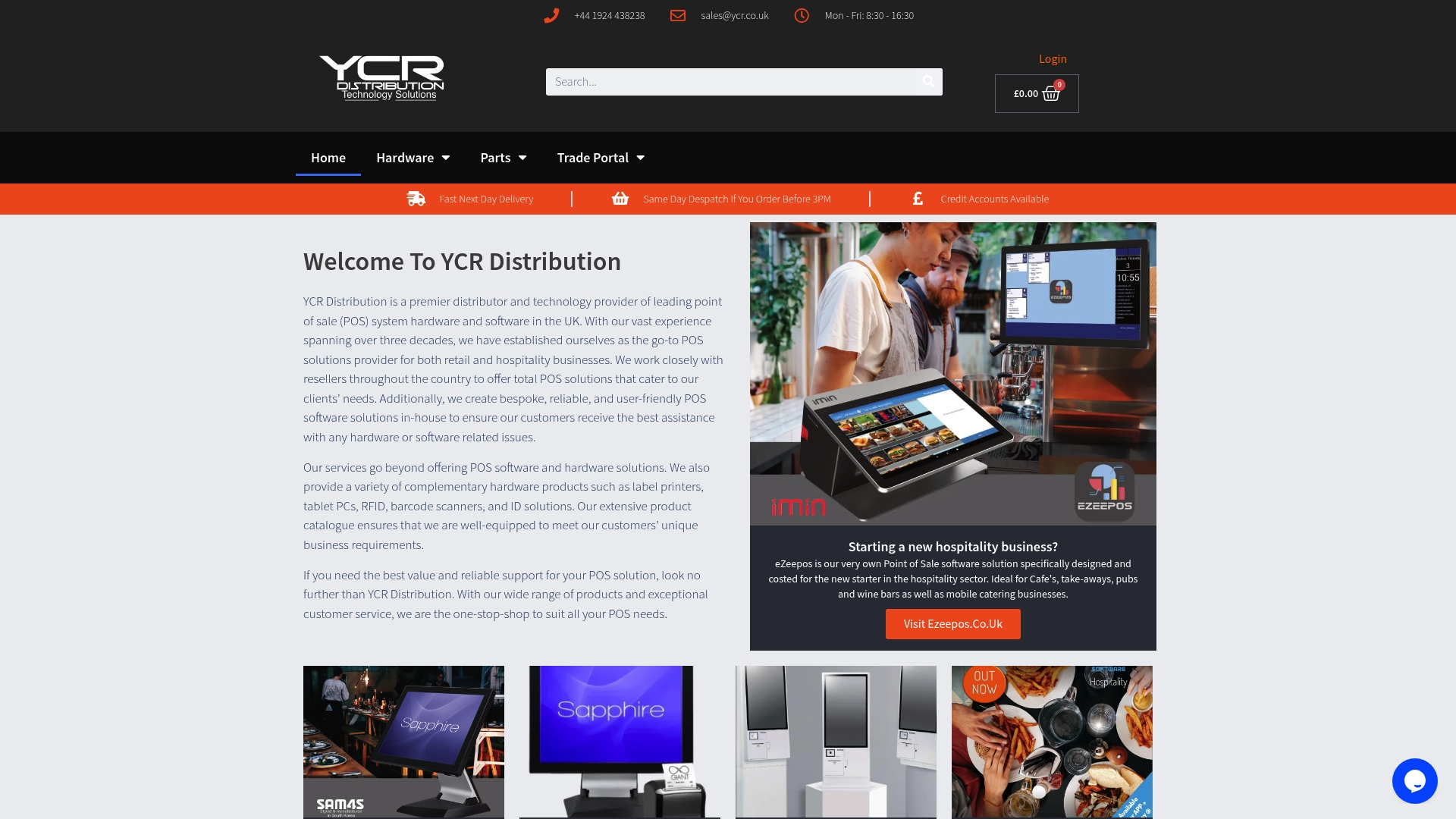
Whether you need a compact solution for a single-site café or a comprehensive multi-terminal system for a restaurant chain, YCR’s product specialists help identify hardware that matches your operational requirements and budget. Their POS hardware terminology guide demystifies technical specifications, whilst their comprehensive selection guide walks you through evaluation criteria step by step. Next-day delivery and same-day dispatch options ensure you can upgrade or expand your system quickly when business needs change.
Frequently asked questions
What is POS hardware?
POS hardware encompasses the physical devices used to conduct sales transactions and manage operations at point of sale locations. This includes terminals, barcode scanners, receipt printers, cash drawers, payment terminals, and customer displays. Each component plays a specific role in processing transactions efficiently whilst maintaining accurate records.
How do I know which type of POS hardware suits my business?
Start by assessing your industry sector, business size, and typical transaction volume. Retail operations with large product catalogues need robust scanning capabilities, whilst hospitality venues require kitchen printers and multiple terminals. Also evaluate your POS software compatibility, required payment methods, and staff technical proficiency. Creating a prioritised list of must-have features helps narrow options to hardware that genuinely fits your operational model.
Can I mix and match POS hardware components?
Mixing components from different manufacturers is possible but requires careful compatibility verification with your POS software. Standardising on compatible brands typically simplifies integration and support, though flexibility allows you to optimise each component for specific needs. Always confirm that peripheral devices will communicate properly with your main terminal before purchasing.
What maintenance does POS hardware require?
Regular cleaning prevents dust and debris from affecting scanners and printers, whilst software updates ensure security and functionality. Thermal printer heads require periodic cleaning to maintain print quality, and barcode scanner windows need clearing to preserve scanning accuracy. Prompt troubleshooting and professional repair when issues arise minimises downtime and keeps operations running smoothly.
Recommended
- Restaurants – YCR Distribution – UKs Largest Independent POS VAR.
- Take-Away – YCR Distribution – UKs Largest Independent POS VAR.
- POS hardware checklist for UK retail and hospitality 2026
- POS Hardware Explained: Impact on Hospitality Efficiency
- Smile and Pay solution TPE encaissement par CB | Shifter